If 2026 was Jarren Duran’s floor, his floor has value: above average outfield defense, good baserunning, low-contact bat but with some pop. Of course we’ve seen his ceiling, in 2024, in which he gathered a significant number of MVP votes. There will be teams who’ll take that floor on the chance that Duran will regain some of that ceiling.
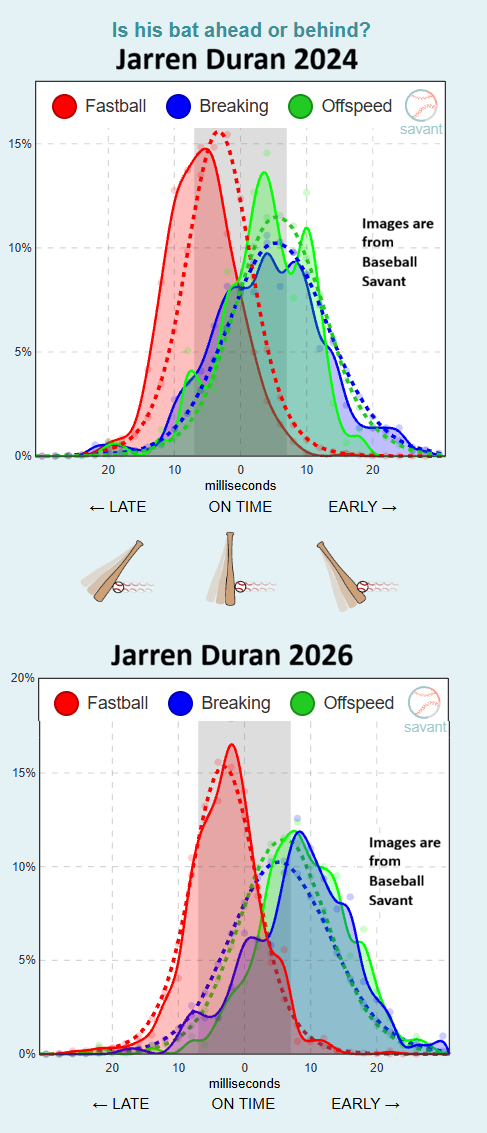
And the fix may be a simple as making him swing more slowly. Because that’s what he did in 2024. If you look at the Bat Tracking section of Jarren Duran’s Baseball Savant page, you’ll see that he was swinging more quickly in 2026 than he did in 2024. He was on average a slightly opposite field hitter in 2024, while being on average a pull hitter in 2026. You’ll also see that in 2024 he was more on-time than early on offspeed and breaking pitches, while in 2026 he was more early than on-time. A team that has noticed this could pick up Duran, convince him to slow down his swing a bit so that he’s on time for more of his swings, and reap some benefits.
Here are those images from Jarren Duran’s Baseball Savant page. The dashed lines represent the league-average curves.
But the Red Sox could do that, too. But now we have a logjam in the outfield, right? Four starter-worthy players for three positions?
Well, in 2026, thanks to injury, it took 4 of those guys to keep 3 of those guys on the field throughout the year. And 2025 was kind of the same story. And with Yoshida out much of both years, the DH role also helped give regular playing time to all the starting-caliber outfielders.
So frankly I don’t see a logjam, and I don’t see much value in trading Duran for whatever you can get. His presence on the roster solves more problems than it causes, in my book.
As for causing more problems than they solve, I’ll give that honor to Trevor Story, with Masataka Yoshida as a runner up. Both due to earn more than Jarren Duran in 2027. Even if having to cover a lot of their salary in a potential trade, the Red Sox might still shed enough payroll in a Story or Yoshida trade to pay most of Duran’s 2027 salary.
The Boston Red Sox have been said to have a logjam in the outfield because they have four starter-worthy outfielders in Wilyer Abreu, Ceddanne Rafaela, Roman Anthony, and (at least according to some) Jarren Duran. Of course they can use the DH position to field all four at once, but their other main outfielder – Masataka Yoshida – usually holds that position thanks to his defensive shortcomings, and his big contract means he’s not going anywhere. But thanks to injuries, they haven’t needed to bench any of these guys much at all, and so the outfield logjam hasn’t really looked like much of a logjam.
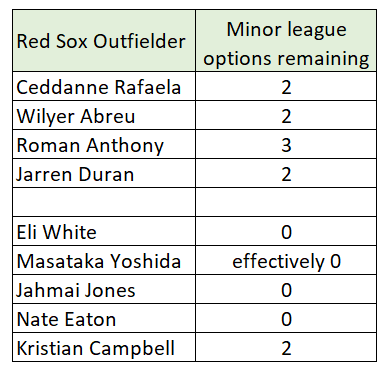
But I’m here to tell you there is another outfield logjam on the Red Sox, and it’s among the other outfielders on the 40-man roster (plus Yoshida). It’s a hard one to notice, though, because it has to do with their number of minor league options remaining, and data on that can be hard to find. I use SoxProspects.com to find them for the Red Sox, by going to their 40-man roster page. If you go there, you’ll see these numbers for the Red Sox outfielders:
The main four all have minor league options remaining. But of the five others, only Kristian Campbell has options that the Red Sox can be sure they can exercise. Yoshida technically has some, too, but there is a provision in his contract that requires the Red Sox to get his permission if they ever want to use them, and it’s assumed that he would never grant such permission.
So here’s what this means. Suppose the Red Sox make no changes to their outfield personnel over the winter. Opening day is approaching, and they have to get the major league roster down to 26. Teams will typically bring 5 outfielders, 6 infielders, and 2 catchers onto that roster. After Rafaela, Abreu, Anthony, and Duran, that leaves room for one more outfielder. Now the rules say that even if a player on the 40-man roster was playing in the minors at the end of the previous season, as Nate Eaton was, he will still need to be optioned to the minors at the start of the next season, if that’s where they want him to be. So that means after keeping one of these backups to sit on the major league bench, the other 4 would need to be sent to the minors.
Kristian Campbell can just be optioned to the minors. But the other three cannot be. They would need to be Designated For Assignment (DFA’d) instead, if the Red Sox want to send them to AAA. But that sends them through waivers, where any other MLB team could claim that player. There’s a chance that the Red Sox could lose all three, and then their outfield depth would evaporate.
This is a problem, and the Red Sox surely have recognized it. One way out is to trade several of these depth pieces for outfielders that do have options remaining. Or they could trade them for whoever they can get, then acquire through free agency or other trades some depth outfielders with options.
There’s no rush to do this based on the logjam I’ve described here – they can take all winter, into spring training, to get it done. But there is another roster crunch coming that has some urgency to it, and it could give the Red Sox a chance to “kill two birds with one stone”, as they say. Five days after the World Series ends, players who have been on the 60-day disabled list must come off that list. But putting a player on the 60-day disabled list takes them off the 40-man roster, and taking them off the list puts them back on it. Well the Red Sox have 7 players on that list. That will add 7 players to the 40-man roster in just 3 days (as it is now two days since the World Series ended). They have three players who became free agents yesterday, which has opened 3 spots on the 40-man, but when these other 7 coming back to it, there will be 4 players who they cannot fit. So in the next 3 days they must get 4 players off of the 40-man roster. To do it, they can trade players for prospects, or they can DFA players. Trading gives you something back, so that would be the preferred route.
And the Red Sox have already done this. Yesterday they traded Nate Eaton for 18-year-old pitching prospect Jareth Rayo, a rookie league pitcher. Because Rayo was not on the Athletics’ 40-man roster, he does not go on the Red Sox 40-man, but Eaton comes off. That creates one space, out of the four they need.
Yesterday the Red Sox also traded shortstop Tsung-Che Cheng to the Tigers for cash, clearing a second spot.
I’m expecting the Red Sox to attempt to trade one more of these outfielders over the next 3 days. My bet would be on Yoshida, who has been a reliable contact bat, but one whose run value is (as measured by OPS+ or wRC+) has only been slightly above average. Jahmai Jones is kind of a right-handed version of Yoshida, but his bat has shown more promise than Yoshida’s of late, and he’s a little better than Yoshida on defense. Moving Yoshida will be more difficult, though, because of the $18M he’s owed this year; the Red Sox would almost certainly need to pay for some of it to get a deal done. The complications that brings may make it impossible to do in the short time frame of the next 3 days.
Whether the Red Sox do it now or do it later, I’m expecting a lot of turnover among their depth outfielders by opening day of 2027.