Friday night (April 18, 2026) the Boston Red Sox got a thrilling 1-0 win in 10 innings over the Detroit Tigers.
Which pitcher did the most to help them win?
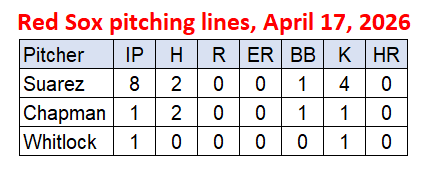
Here are the stat lines of their 3 pitchers in this game:
It should be clear that Ranger Suarez’s 8 shutout innings did more to help the Red Sox win than did Aroldis Chapman’s and Garrett Whitlock’s 1 shutout inning apiece.
But the win went to Whitlock, not Suarez.
This happens a lot, in my opinion. Too much. So many pitchers who deserve the win don’t get it, because of rules made in 1950 to finally consolidate all the competing standards for which pitcher should get the win. And when the top pitchers were still the only pitcher to pitch in the game for their team, in most of their starts. Changes in the game have made the use of relief pitchers an every-game occurrence, and have exposed the unfairness of these rules.
First we determine how many runs per inning the Red Sox scored in the game. The scored their 1 run with one out in the 10th inning, so that’s 1 run over 9 ⅓ innings, or 3/28 runs per inning, or about .107 runs per inning.
Now we credit each Red Sox pitcher in the game with that many runs per inning they pitched.
Pitcher
Runs credited for innings pitched (RC)
Ranger Suarez
8 IP x 3/28 = 24/28 or .857 runs
Aroldis Chapman
1 IP x 3/28 = 3/28 or .107 runs
Garrett Whitlock
1 IP x 3/28 = 3/28 or .107 runs
Now from this we subtract the actual runs each pitcher allowed in the game.
Pitcher
Runs Credited (RC)
Runs allowed (R)
Runs Ahead (RA)
Ranger Suarez
.857
0
.857
Aroldis Chapman
.107
0
.107
Garrett Whitlock
.107
0
.107
This gives a number for each pitcher called “Runs Ahead”. In this case, because no runs were given up by any Red Sox pitcher in Friday’s game, it’s the same as the Runs Credited for innings pitched for each pitcher.
The win then simply goes to the pitcher with the greatest number of Runs Ahead. In this case, it goes to Ranger Suarez, who as we decided before, did the most to help the team win the game.
Notice that the calculation of Runs Ahead is based on only two numbers – runs allowed, and innings pitched. That was a deliberate choice. These numbers are the only two real contributions a pitcher makes toward the goal of winning or losing a game. All other stats may describe how the pitcher gets to that goal, but only these two record progress toward the goal.
It’s a method that, I believe, will most closely align with the judgement “which pitcher did the most to help his team win the game”. I’d like to see it replace the current flawed methods. And then Ranger Suarez can get his win back.
Here are some other previous posts I’ve made about this method.
Serves me right for basing an analysis on media rumors.
In two previous posts (here and here), I compiled hitting, baserunning, and defense statistics for every 2B/3B/SS candidate the Red Sox were connected with this offseason by various news articles. One possibility that never came up in those articles was Isiah Kiner-Falefa, so I didn’t include him. So of course that’s who the Red Sox sign. So I started creating this update to my previous comparisons, to include him.
That’s when things really got weird.
In rapid succession, the Red Sox claimed infielder/catcher Mickey Gasper off waivers, then infielder Tsung-Che Cheng, then infielder Brendan Rodgers, then traded infielder David Hamilton and two pitchers to the Brewers for infielder Caleb Durbin, infielder Andruw Monasterio, and infielder Anthony Seigler. That’s 7 new infielders with major-league experience acquired in a 6-day span, none of whom I’d provided any analysis for previously. So, I needed to do some serious updating. (And Red Sox prognosticators in the media need to seriously update their prognosticating game, because they were all very wrong.)
It took me a while, but here it is finally. I added the two who are likely to stay on the major league roster to the comparison of acquisition options. I’ve added all of them (except for Tsung-Che Cheng, who has played only 3 games in the majors) to a comparison of actual Red Sox infielders. I kept David Hamilton in that comparison, for now.
About this chart
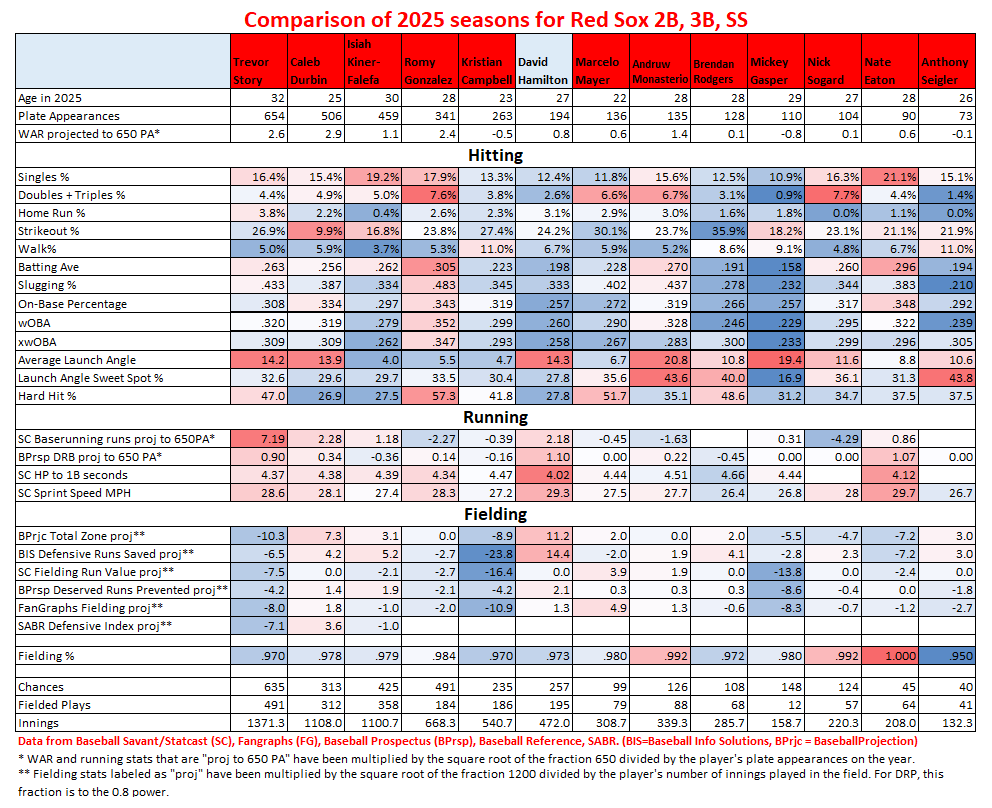
Numbers that are red are above average, the redder the better. Numbers in white are average. Numbers in blue are below average, the bluer the worse.
As before, the order was chosen based on number of plate appearances in 2025. Most on the left, least on the right. I made the header red for players currently on the Red Sox.
The WAR number has changed a bit. As before, “WAR” refers to the average of the Baseball Reference WAR, the FanGraphs WAR, and Baseball Prospectus’ WARP. But my projection to 650 plate appearances is not done by simply assuming each player would accumulate WAR at the same rate they did in their smaller number of plate appearances. There is a good reason for this. There is always some randomness in the results; some would refer to it as luck. While players with more plate appearances will see bigger swings in their totals due to luck, the size of those swings will be a smaller fraction of their overall numbers. So I switched from multiplying players’ WAR by
To multiplying by
This ensures the scaled up effects of luck are not bigger for players with low PA than they are for players with 650 PA, even though it likely underestimates what their full-year contribution would have been based on actual talent.
I made the same adjustment for the first two baserunning stats.
For fielding stats, the adjustment was to multiply by
The one exception was for DRP, where the folks at Baseball Prospectus seem to have done some adjusting already. For this, the best adjustment worked out to be multiplying by
The Charts – comparing to other offseason targets
Here are the current top Red Sox “non-first-base” infielders (with red headers) compared to other players mentioned as potential offseason acquisitions.
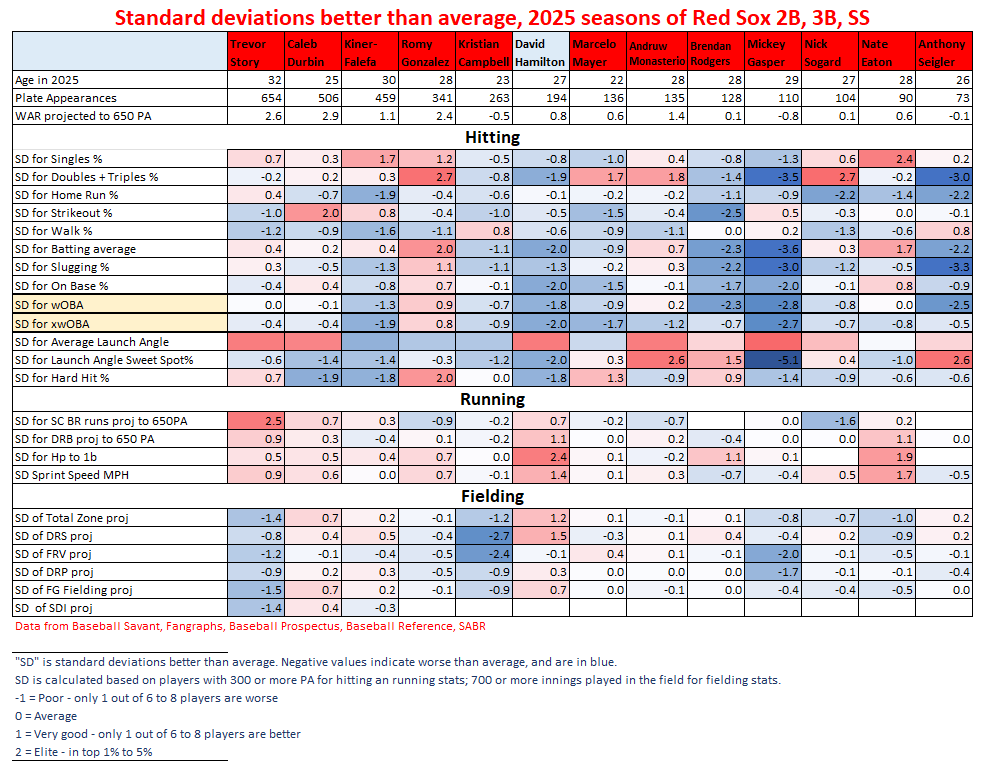
Here are the same stats expressed in standard deviations from the average. These numbers provide a standard way of telling how good a player’s stat is compared to the rest of the players in the MLB. (It also doesn’t suffer the problem that percentiles has, which is that what looks like a big difference for players average numbers looks like a small difference for players with the best or worst numbers. Although with the log-normal distributions, what looks like a big difference among the worst players will look smaller among the best players, though the effect is not expected to be as pronounced.)
First thing to note is that Kiner-Falefa is the worst hitter in this list. He looks like what Marcelo Mayer was in 2025, but with less power and a low strikeout rate. And Mayer is expected to get better. Kiner-Falefa gets a very high rate of singles; an average amount of doubles; a low strikeout rate, for a good batting average. But his extremely low walk and home run rates tanks the value of his bat. If they need a guy to put the ball in play, he’s a good choice. Otherwise, his bat has little value.
Caleb Durbin, on the other hand, had pretty much a league-average bat in 2025, with a very low strikeout rate. As he was a rookie, we can look for there to be improvement going foreward. His launch angle and hard hit numbers show there’s some room for improvement in squaring up the ball.
Durbin’s baserunning was above average; it’s about the 4th best on this list of 17 players. Kiner-Falefa’s was average or just above average.
Durbin was one of the top 5 fielders on this list, solidly above average. Kiner-Falefa’s fielding, as with baserunning, was more average or a little above average. Durbin played almost exclusively at third base, so it’s hard to say how he’d do elsewhere. Kiner-Falefa has played many positions in his career, and shortstop more than anywhere else, although as a fielder he’s been much better at second and third. He’s also a good outfielder. He’s even caught a lot in his career, though he’s not good at it.
On the whole, the Red Sox did well in picking up Durbin. He’s pretty much better in every way than Kiner-Falefa, and compares well to the other players on this list who fans coveted. He’s a 3-tool guy who could grow into being a 4 or 5 tool guy, if his bat improves. Definitely starter material, and young and controllable.
More charts – comparing to other Red Sox infielders
Here are the charts comparing all the new guys – Caleb Durbin, Isiah Kiner-Falefa, Andruw Monasterio, Anthony Seigler, Brendan Rodgers, and Mickey Gasper (leaving out Tsung-Che Cheng as he only played in 3 games) – to existing Red Sox infielders Trevor Story, Romy Gonzalez, Marcelo Mayer, Nick Sogard, Nate Eaton, and even Kristian Campbell (though I don’t think his 2025 is representative of who he will be – well you could say the same of Mayer). I’m keeping David Hamilton in for now, for comparison purposes. Again, this leaves out the first basemen.
By my judgement, the top three in this bunch are Trevor Story, Romy Gonzalez, and Caleb Durbin. Until Marcelo Mayer is more major-league ready, I would want to see those three get the lion’s share of the playing time.
There is an interesting comparison to be made between newcomer Andruw Monasterio and incumbent utility guys Romy Gonzalez and Nick Sogard. I’ll go into that in a little depth below. But first, here are a few quick notes about the other guys.
Some quick observations
The guy they gave up, David Hamilton, was the best defender of the bunch. He was also one of the three best baserunners. His bat was poor, but I had the feeling that it would have been better with regular playing time. We must remember that with more playing time in 2024, he had a league-average bat. His good launch angle gives him occasional pop.
Andruw Monasterio’s numbers look really close to Nick Sogard’s, with slightly better defense and more pop in his bat. It makes him an overall more valuable player, and they are close in age. Sogard’s a solid, hard-nosed backup player, but he could see less time on the roster now.
Brendan Rodger’s bat was not good, but historically it has been better. He especially has had good numbers against lefties, and that could get him some playing time on this roster that just lost lefty-mashers Rob Refsnyder and Alex Bregman.
Mickey Gasper was just awful. Anthony Seigler’s bat was not good. These guys are depth options only. Hoping we don’t see them in the majors, unless they somehow get better.
Nate Eaton is a very intriguing player. He may be primed for a breakout season. We’ll see.
Not sure what to expect from “Big 3” alums Kristian Campbell and Marcelo Mayer. Hopefully one of them turns the corner in 2026.
Gonzalez/Monasterio/Sogard similarities
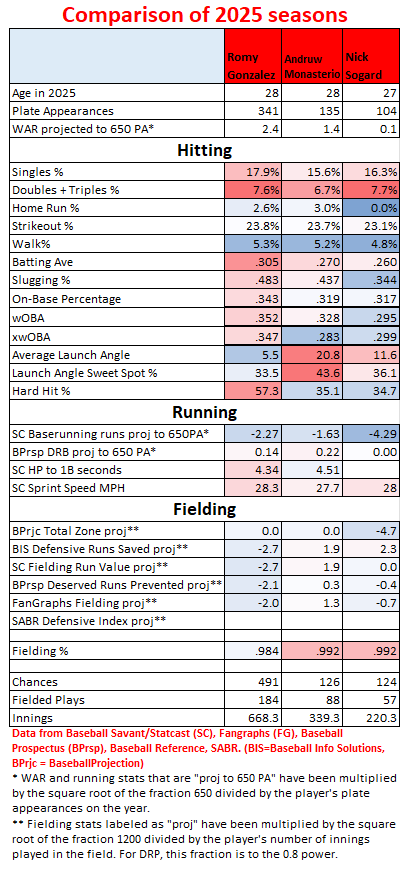
The top 5 lines of the hitting section of the chart break down the rates at which the hitters get different outcomes. Look at how similar those are for Romy Gonzalez, Andruw Monasterio, and Nick Sogard. Hang on, let me put together a version of the chart that has just those three players:
Those are very similar numbers in those top 5 hitting lines for singles, doubles & triples, home runs, walks, and strikeouts. Andruw Monasterio hits like Nick Sogard with more pop, and like Romy Gonzalez with fewer singles (his doubles numbers are a bit lower, but they should get boosted by Fenway Park, so I’ll consider them all equal there).
They’re all similar in age.
They’re all well-below-average baserunners despite having average to above-average speed.
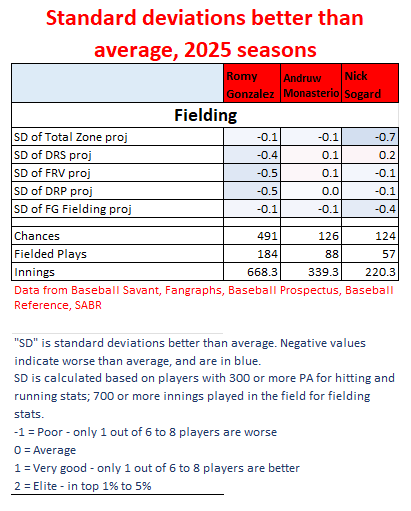
Monasterio stands out a bit on defense, though. While the numbers for their defensive metrics seem to be saying that Monasterio is a little above average defensively while Gonzalez and Sogard are a little below average, if we look at my chart that expresses these defensive metrics as standard deviations above or below average, we see it saying that Monasterio is average, while Sogard and Gonzalez are below average;
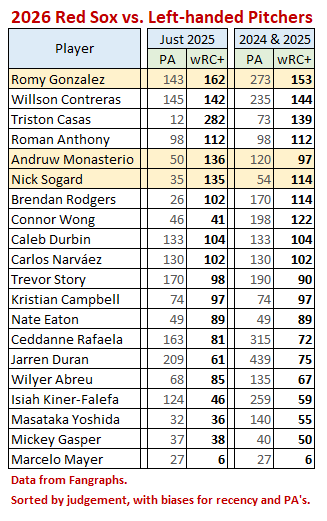
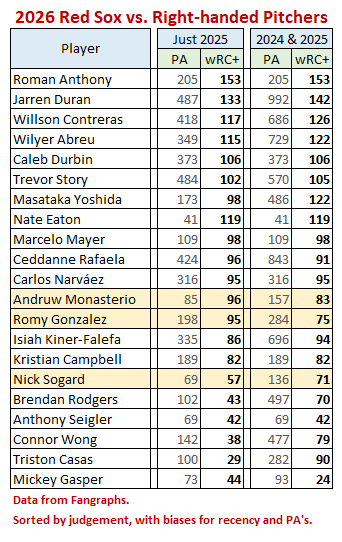
They are also all strong against left-handed pitching. While Sogard is a switch hitter and the other two are righties, their platoon splits are those of right-handed hitters. Here are tables of current Red Sox position players against LHP and RHP:
While Gonzalez is the clear leader against lefties, they’re all (at least recently) well above average against them. Gonzalez and Monasterio are approaching average against righties, with Sogard a good bit behind them.
All told, Andruw Monasterio represents an upgrade over Nick Sogard, and a good alternative to Romy Gonzalez, should Gonzalez not be fully recovered from injury by opening day. While fans may appreciate Sogard’s solid if unspectacular play, I expect they’ll be seeing less of him on the field for the Red Sox going forward.
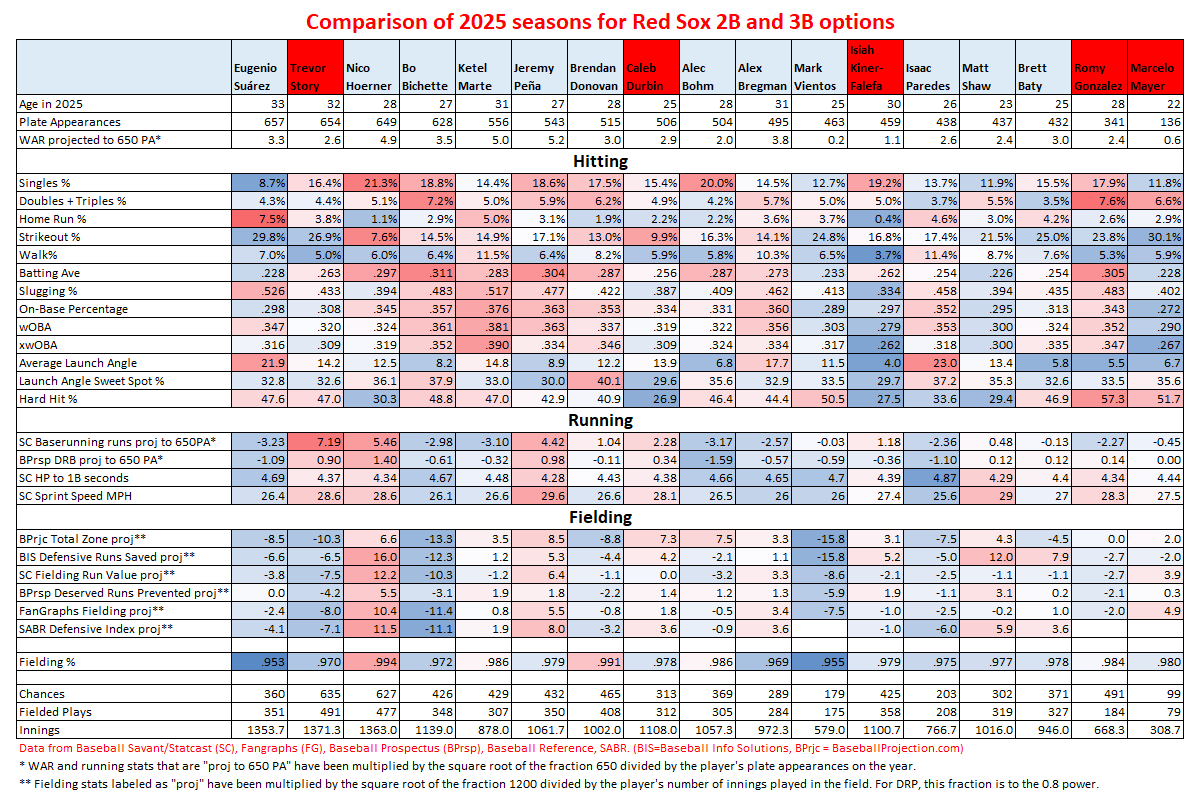
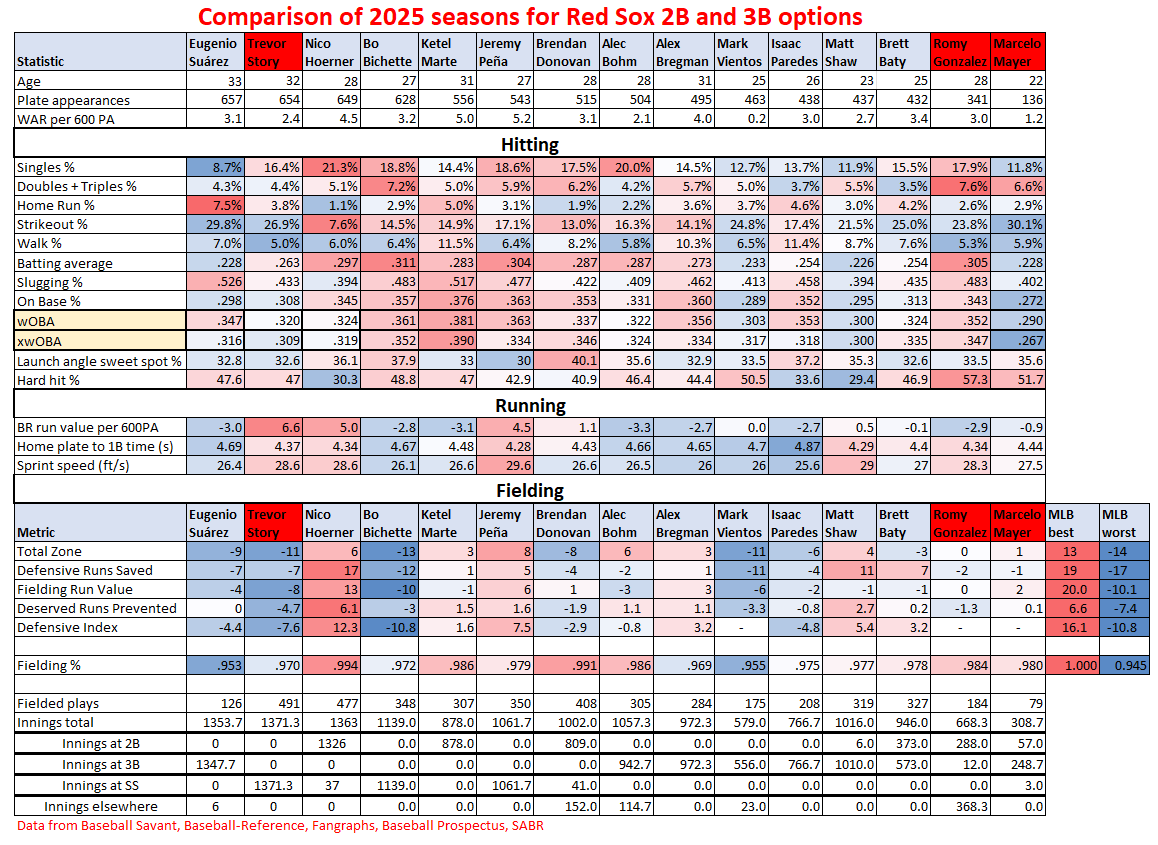
Three weeks ago I posted charts comparing the 2025 seasons of players that, at least in the press, were being considered as options for the Red Sox to play at second base and/or third base in 2025. Most of these players not currently being part of the organization. Much has changed these past 3 weeks, and so an update was called for. Below find the updated chart with new players added, some utility players removed, and a couple of extra stats added to make the picture a bit more complete. I’ve kept Alex Bregman, Bo Bichette, and Ketel Marte on the list even though they are no longer options, just to serve as reference points. I’ve also highlighted names of players currently on the Red Sox in red.
As before, the order was chosen based on number of plate appearances in 2025. Most on the left, least on the right.
Note in the top section I added a WAR per 600 plate appearances line. This WAR is the average of the Baseball Reference WAR, the FanGraphs WAR, and Baseball Prospectus’ WARP. I then scale it to what it would have been had the player accumulated WAR at the same rate through the season, and had 600 plate appearances. This makes it more like a rate stat, and I feel it makes for a better comparison for players with varying amounts of playing time.
I also added a line in the Running section for Baserunning Run Value per 600 plate appearances. This starts with the Statcast Baserunning Run Value numbers, which combines the run value of extra bases attempted and the run values of stolen base attempts. I then scale to 600 plate appearances so that players with less playing time don’t get shoved to the middle of the pack. Trevor Story, Nico Hoerner, and Jeremy Pena all excelled here, and they’re all fast runners. Seven players were duds at baserunning; six of those are slow runners; the other one, Romy Gonzalez, is actually a fast runner. He needs to work on his baserunning game.
Despite that, I honestly think that Romy Gonzalez is the best overall infielder the Red Sox have right now. I would have expected to tell you it was Trevor Story, but I am surprised how poorly his numbers show here. He did have a big early-season slump with the bat, so maybe I should assume better 2026 numbers at the plate for him. The biggest surprise was defense – not a lot of errors, but very poor metrics for runs prevented. Perhaps he was less daring after all the injuries over the previous 3 years. Absolutely great on the basepaths, which was nice.
Romy, though poor on the basepaths, and average on defense, blossomed at the plate to produce the second best results on the team there, behind only Roman Anthony. It was the payoff for some intense offseason work with a good hitting coach. What really stands out is the elite hard-hit rate (5th best in the MLB, behind Anthony, Schwarber, Judge, Ohtani). This was tempered by a very low launch angle and very high ground ball rate. There is potential here for a breakout season in 2026.
Marcelo Mayer similarly had a very good hard-hit rate tempered by a low launch angle (well Roman Anthony did, too, actually), but in terms of overall results at the plate, besides a good rate of doubles (Fenway can do that for you), in every other way his results at the plate were poor. Good-not-great defense, okay baserunning. Right now I consider him “unproven” as a major leaguer. Most fans seem to assume he’ll be a regular and Romy Gonzalez should be the bench/utility guy, but I want to see more from Mayer before I’d consider him “regular starter” material.
So what about the possible imports? Jeremy Pena is a name I heard mentioned – he definitely tops the list in terms of overall value. I don’t know how realistic it would be to acquire him, but he looks like a real solid 5-tool guy in his prime. He’d knock Trevor Story out of the shortstop position.
Nico Hoerner, a second baseman, is the top defender on this list, just outstanding, and one of the best baserunners, too. He puts the ball in play and gets a lot of singles, but has no power. The least of anyone on this list.
Brett Baty, who plays 2B and 3B, is perhaps the most balanced of the rest, good at everything, great at nothing. Average bat and baserunning, above average defense.
Eugenio Suarez is perhaps the most imbalanced of the rest. He does one thing well: mash home runs. But he does that exceptionally well. Worst at singles, okay at doubles, lots of strikeouts. Poor baserunner, very poor fielder. Yet still valuable for the home runs. How will his bat play in Fenway, though?
Isaac Paredes has a strong bat; lots of home runs, good numbers for walks and strikeouts, though his low expected wOBA says he may have been lucky in 2025. And his bat is tempered by poor baserunning and poor defense at 3B.
Brendan Donovan, a second baseman, has a very good overall bat that lacks power. Good/okay baserunning, substandard fielding.
Alec Bohm, a third baseman, is similar. Average or slightly above average bat with no power. Poor baserunning, okay fielding.
Matt Shaw is young – was just 23 last year, a rookie. He’s fast, and provided excellent third base defense. His bat didn’t live up to expectations, but that happens in rookie years. He showed some power, was average with strikeouts and walks, but a low batting average, slug, and OBP. His value comes in whatever faith there is that his bat will develop. He could become very good.
The last one on the list is Mark Vientos. I’m not sure why he’s considered an option. Oh, I see, he had one good season in 2024. But going by 2025, he’s got some pop to his bat, but brings nothing else to the table. Low OBP, low overall bat value, slow, poor defense at third base. He doesn’t bring an improvement over any of the existing Story-Mayer-Gonzalez trio. There’s no point in acquiring this guy.
In the end, here would be my reaction to the Red Sox acquiring one of these guys:
Jeremy Pena: Enthusiastic yes.
Nico Hoerner: Good with this.
Matt Shaw: Probably good with this.
Baty, Suarez: Maybe good with these.
Paredes, Donovan, Bohm, Vientos: No thank you.
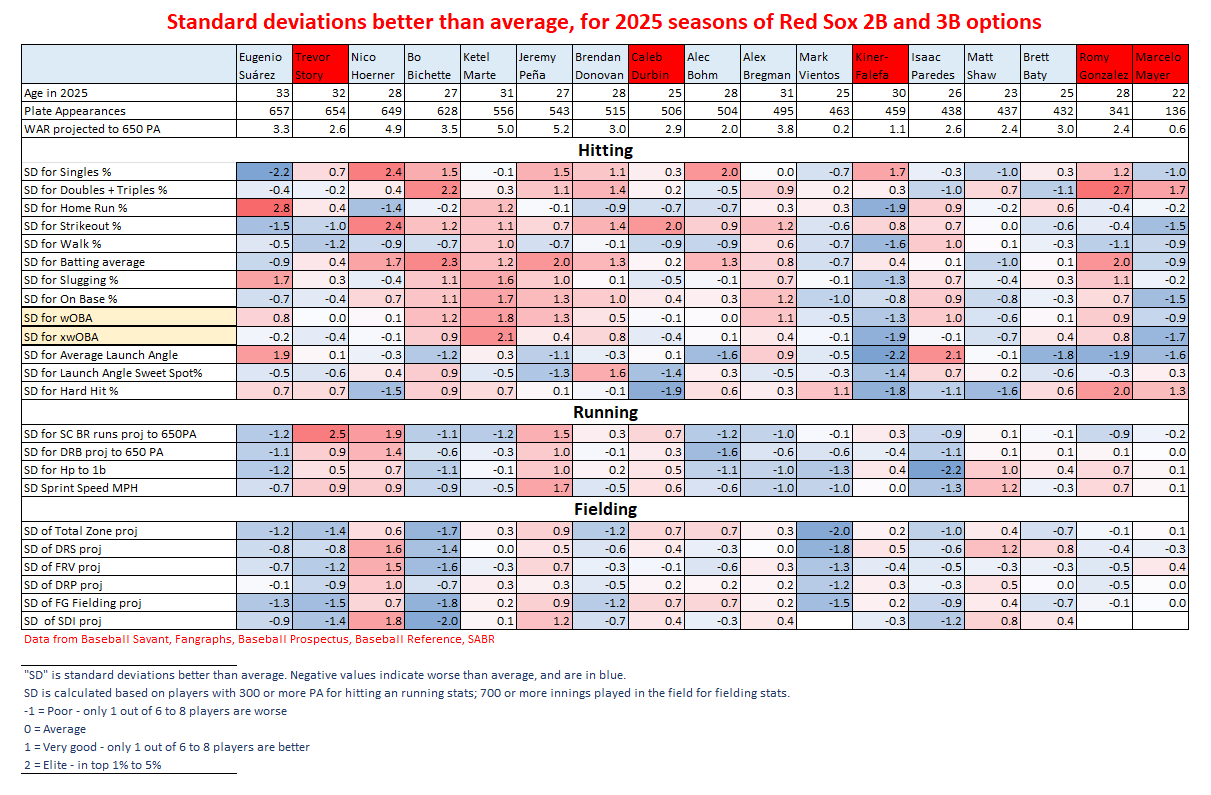
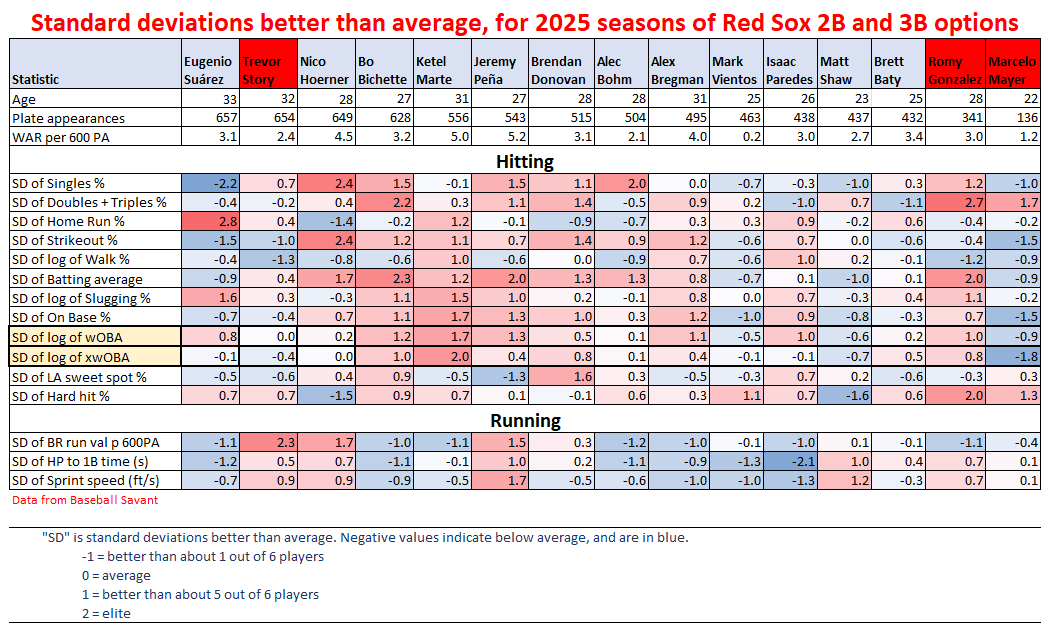
Here are the same stats for hitting and running presented in terms of standard deviations from the mean.
A lot of names have been mentioned as possible second basemen or third basemen for the Boston Red Sox in 2026. Some are already on the roster (Marcelo Mayer); some could be added by trade (Ketel Marte, Brendan Donovan); some could be picked up as free agents (Bo Bichette, Alex Bregman).
There are other names on the current Red Sox roster that have played significant time at second and/or third base, but are not mentioned in articles about who will get regular playing time in the Red Sox infield. And I have issues with this. Specifically, I have issues every time I read that Marcelo Mayer is presumed to be the player who will round out the infield after they acquire a second or third baseman. Because when I look at what Romy Gonzalez did in 2025, I see a guy who is no longer a platoon player, he’s a guy that deserves to play every day. In addition to that, his elite hard-hit rate makes him a breakout candidate, and I’m saying that despite the fact that he was already the second-best hitter on the Red Sox in 2025. His defense is not bad, it’s good enough, and his baserunning is a plus. He’s proven at the major league level, in ways that Marcelo Mayer isn’t. He can be relied on to produce good results in ways that Marcelo Mayer can’t yet.
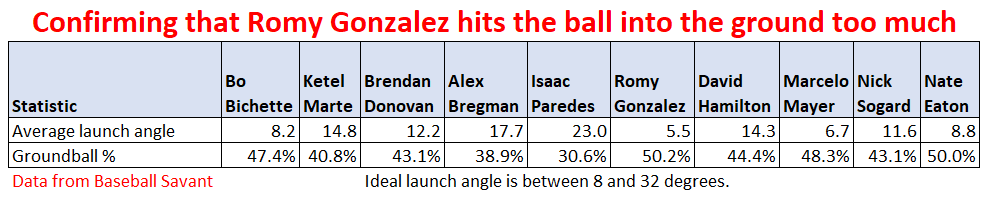
The thing that will allow him to break out? If he just stops hitting the ball into the ground so much. Of all the guys I’m comparing in this article, he does that the most. His average launch angle is the lowest. The result is that he’s one of the best in baseball at hitting doubles and triples, but his rate of home runs is a little below average.
He could also stand to chase less, and correspondingly increase his walk rate while decreasing his strikeout rate.
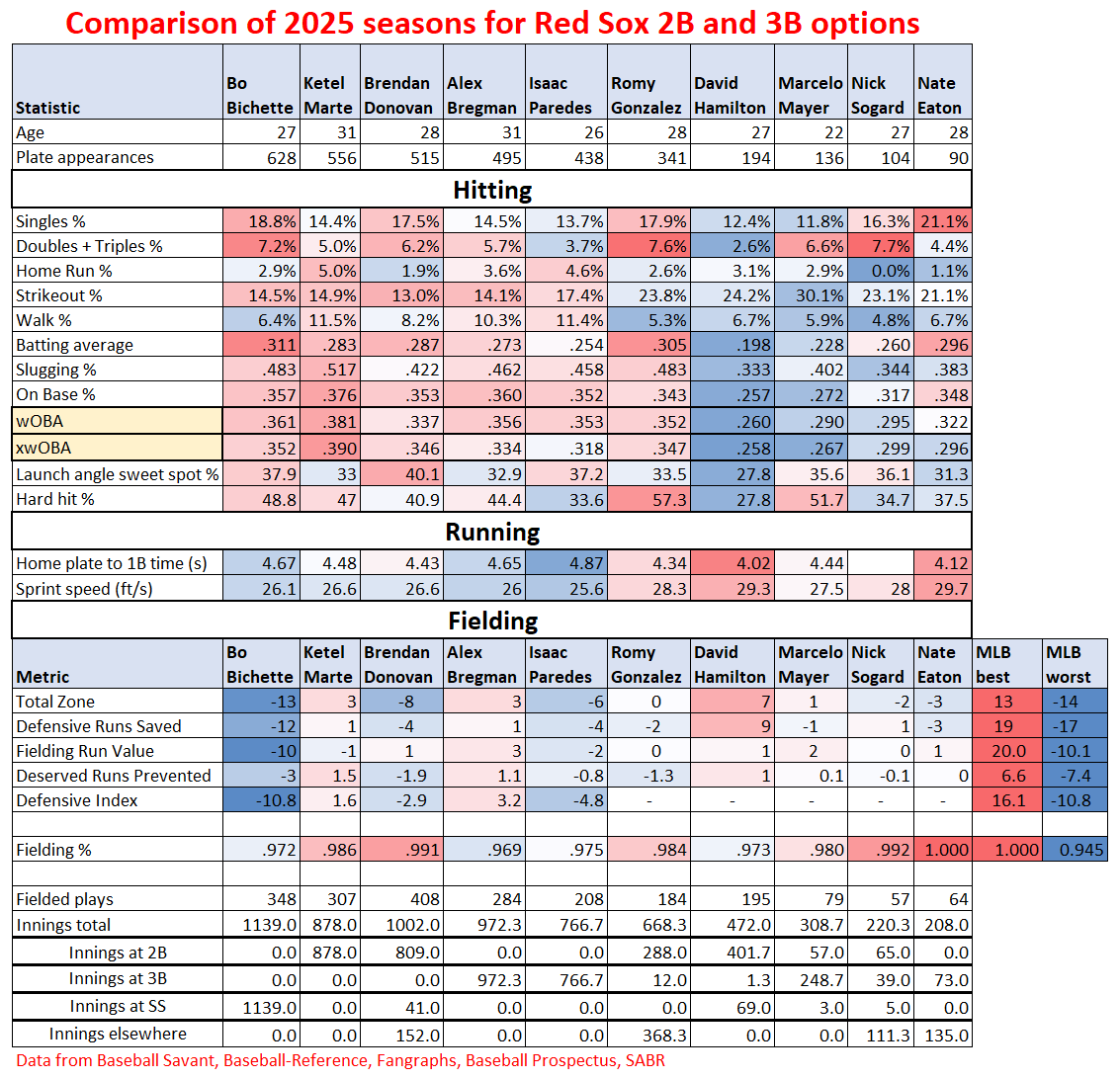
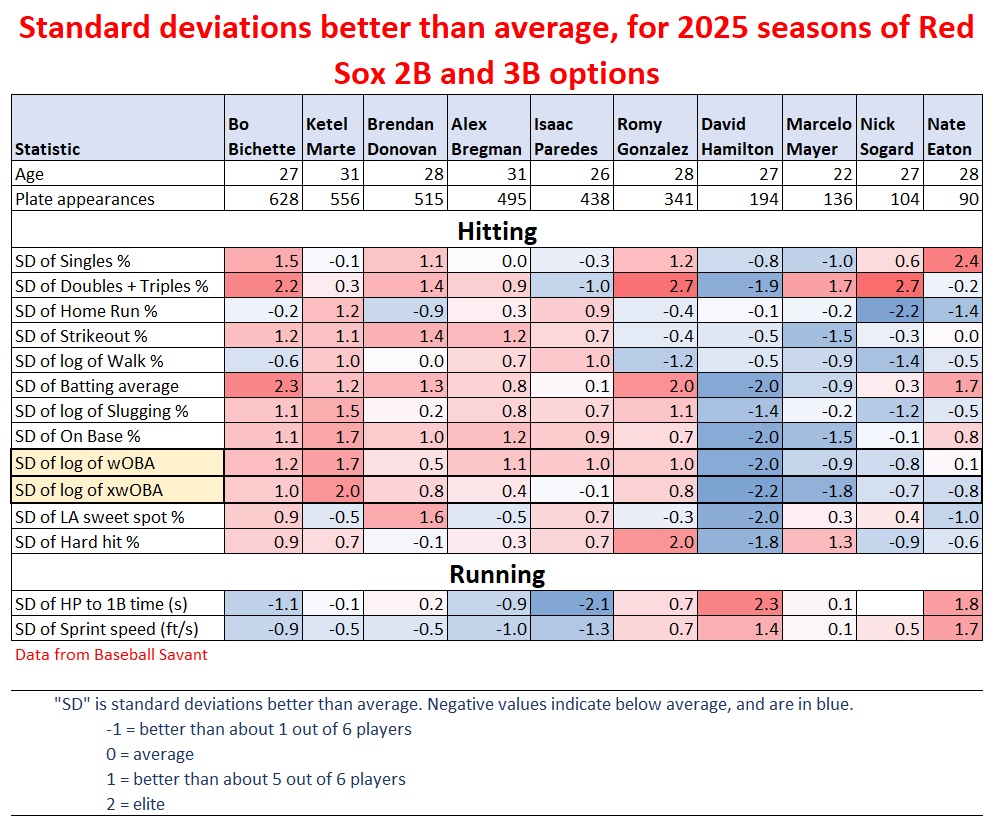
If you care about home runs, stikeouts, and walks, any of the 5 potential acquisitions (Bichette, Marte, Donovan, Bregman, Paredes) will be an improvement over Romy Gonzalez. But if you care about overall results at the plate, only Ketel Marte is looking like an improvement over Gonzalez. And when you factor in fielding and baserunning, there are some even bigger advantages for Gonzalez over most of these 5.
I’d hoped to discuss more specifics about comparisons of individual players, but I am finding it hard to find time to write this article. So I’ll just show you the tables I created to make these comparisons easy.
Here are the comparisons I’ve created for these players. The players are ordered left to right by most plate appearances in 2025.
Red means the number is above MLB average; blue means it’s below MLB average. White is MLB average. I set the deepest red to 2.8 standard deviations better than the mean (usually above, but sometimes below), and the deepest blue to 2.8 standard deviations worse than the mean. For hitting and baserunning, a table showing the numerical values of these standard deviations follows.
These same statistics expressed as standard deviations better (red) or worse (blue) than MLB average is below. In some cases, the data was more log-normal than normal, so I used standard deviations of the logarithm of the stat. These are labeled as such.
Here are the numbers supporting my previously mentioned statement that Romy Gonzalez can unlock a lot more power if he learns to elevate the ball. He hits it into the ground too much.
I hated the trade of Willson Contreras to my team, the Boston Red Sox, for RHP Hunter Dobbins, RHP Yhoiker Fajardo and RHP Blake Aita. The Red Sox got a good player who doesn’t improve the team, while giving a player who was a personal favorite.
Hunter Dobbins was my favorite pitcher on the Sox, not for how he pitched, but for the things he said. For the competitive fire. For the anti-Yankees fervor. He seemed promising as a #5 starter.
When I say that Willson Contreras doesn’t improve the Red Sox, that hinges on something that I get the feeling that nobody agrees with me on: that Romy Gonzalez has evolved into one of the top bats on the team, whose elite hard-hit rate could turn him into one of the top bats in the game if he could learn to elevate the ball a bit (he hits it into the ground too much). If you go by multi-year track record, people are right about Gonzalez and Contreras; but if you go just by 2025, as I do in my comments to follow, they’ve got Romy all wrong.
I’ve stated elsewhere, when you analyze it carefully, you see that Contreras is no better than Romy Gonzalez at first base. He’s a good player that the Red Sox didn’t need.
A key part of that statement is “at first base”. Romy’s best position defensively has always been first base, where he rates as average by all the different rating systems (he’s a below average fielder everywhere else). Contreras is effectively the same as Romy at 1B in Total Zone, Defensive Runs Saved, and Deserved Runs prevented. Only Statcast’s Fielding Run Value has him significantly higher, where he is a substantially above-average 4.
At the plate? They’re very similar in wOBA, Expected wOBA, and OBP. Contreras gets more walks and home runs, but not a ton more. Romy gets more singles, doubles, triples, and strikes out slightly less. They both chase too much.
Playing in Fenway, Contreras will probably see his doubles numbers catch up to Romy’s, but their home run numbers may get closer too. But Romy is just a slight adjustment away from unlocking a ton more power, as I mentioned above, with his elite hard-hit rate, but tendency to hit the ball into the ground.
Baserunning? Romy is clearly the better one here.
Positional versatility? Slight advantage to Contreras because it’s great to have an emergency backup catcher, but Romy is strong in this category too.
I figured, put Romy at first until Casas is ready, then work things out from there. Get one other infielder, preferably a third baseman, or a Ketel Marte. That would have been best. Anthony, Gonzalez, and Casas could all be giving the Red Sox power in spades if they can all be healthy.
Now instead, Romy plays second base where he’s worse defensively (I hope he gets better), and Casas is kind of blocked. Contreras may be a power hitter, but the Red Sox may not end up with any more power production for his acquisition.
Pete Alonso is one of the best bats in baseball, no question about that. But to get his bat at first base, you have to take with it his awful fielding and awful baserunning. That waters down his value to some extent. But by how much? And how does he compare to players currently on the Red Sox, and other available options?
I’ll present the data here and some other observations, so that you can compare. I’ll finish by talking about whether it makes sense for the Red Sox to add a player or stick with who they have. All the data shown here is from BaseballSavant.
The players to be compared
I picked the 3 first base free agents who were considered the best on the market when this offseason began, and put their stats on the top row of the comparisons below. (I started putting these together weeks ago when Josh Naylor was still a free agent.) On the bottom row I put a top first base trade possibility in Yandy Diaz, and the two top major league first base options on the Red Sox currently, Romy Gonzalez and Triston Casas.
For 5 of the players, I show their 2025 numbers. For Triston Casas, who didn’t play enough in 2024 and 2025 to give us a good idea of what he is, I show his 2023 numbers.
Expected stats
Let’s start with the expected stats. This is where they look at the velocity, launch angle and trajectory of every ball a player put in play, and tally up the probable results based on those numbers.
Focusing primarily on xwOBA, we see that all six players did well, although when you look at the actual values instead of the percentiles, Alonso is clearly separated from the pack, with only Triston Casas giving him a challenge there.
Quality of contact
Now we’ll look at quality of contact.
Alonso had the best overall contact, however Romy Gonzalez had more hard-hit balls. In fact he had the 5th highest Hard Hit% in baseball for players with over 300 PA. (Who was ahead of him? 1. Roman Anthony 2. Kyle Schwarber 3. Shohei Ohtani 4. Aaron Judge.) Yandy Diaz also hit it hard frequently.
But neither Gonzalez nor Diaz get an ideal launch angle (“LA Sweet Spot %”) as much as Alonso does. For both of them it turns out it’s because they hit too many ground balls – Diaz especially. This is likely the reason Diaz’s results aren’t as good as Alonso’s, and for Gonzalez, one of two reasons (we’ll see the other in the next section).
While O’Hearn and Naylor are limited by lower bat speed, O’Hearn improves his results by often having a good launch angle, and Naylor gets a better exit velocity by hitting on the sweet spot of the bat a lot.
Triston Casas’ 2023 comes the closest to Alonso’s 2025 among those pictured here. The differences may only be due to looking at a rookie season versus a veteran in his prime having his best season yet.
Non-contact stats
So that’s what happens when they swing and make contact. What about the numbers when they don’t make contact? Who chases pitches out of the zone too much (Chase %)? Who misses a lot when he swings (Whiff %)? Who walks too little or strikes out too much?
Alonso and O’Hearn are average in these categories. Yandy Diaz is above average, and Romy Gonzalez is well below average. Triston Casas has a great eye, but still manages to swing and miss at an above average pace. Josh Naylor doesn’t chase and doesn’t strike out, but walks an average amount.
Here we have what looks like the other reason Romy Gonzalez doesn’t get better results despite hitting the ball so hard. He chases too much. And while fixing that doesn’t necessarily fix his higher strikeout rate and low walk rate, it ought to at least help.
Fielding and Baserunning
What’s left? Fielding and baserunning.
Here again we see strong similarity between Triston Casas and Pete Alonso. They’re both terribly slow, and awful at both fielding and baserunning. But being slow isn’t the excuse for the rest, because look at Josh Naylor, who is even slower, but manages to be an average baserunner and a decent fielder.
When it comes to baserunning, Romy Gonzalez is the opposite of Josh Naylor. He’s the only one in this group that could be called “fast”, yet he’s still a poor baserunner. Maybe he should get a pointer or two from his teammate Trevor Story, who runs just as fast as Gonzalez but was one of the top baserunners in the game last year. Or maybe we should give him a little credit for being an average or above average baserunner in the past.
As for good fielders, it looks like Ryan O’Hearn is the only one, with Naylor and Gonzalez a little below average. But Gonzalez split his time between first and second base (and some other spots), and when you break his fielding down by position, both in his career and in 2025, he’s been an above-average fielding first baseman, and a below-average fielder everywhere else.
Categorizing these players
So to sum up, I see two basic types of player here.
Pete Alonso and Triston Casas are the power hitters who can get on base, too, but are awful at fielding and baserunning. Yandy Diaz is, too, but with a little less power and a little better baserunning.
In the other category are Josh Naylor and Ryan O’Hearn, who have some power, but not a lot, but still manage to have above-average impact as hitters. And at everything else, they’re average, on the whole.
The 2025 version of Romy Gonzalez belongs in the O’Hearn/Naylor camp, as a well-rounded player with an above-average bat. But he has the raw tools to become much better. He’s got enough speed to become a great baserunner. He’s one of the best in the game at hitting the ball hard, but he hits it on the ground too much, and he misses it too much. And here’s the thing: the parts of his game that are lacking and that are holding him back, are all things he can learn to be better at. He can learn to be a smarter baserunner. He can learn plate discipline. He can learn to hit the ball just a little lower than he does now, to get it into the air more.
The question is, will he?
If he does, he creates a new category, combining the best of O’Hearn/Naylor with the best of Alonso/Casas, and he’d be better than all of them.
Who’s on first?
So what should the Red Sox do? If they can get Pete Alonso in to play first base for them, should they?
Alonso would certainly help the lineup. But if Triston Casas has a healthy year, he’s basically a Pete Alonso clone for much less money.
What if Casas is injured again, though? He sure seems injury prone. Then your backup plan is Romy Gonzalez, who is as good as your second-or-third best first base free agents that were on the market at the start of this offseason. And with the right coaching and effort, could end up being better than all of them in the short term.
So regardless of whether Casas can or can’t play, the Red Sox will have a plus option at first base. They don’t need Alonso to play first base for them.
But Alonso would improve them at DH. But to make that room, they’d need to trade/drop Masataka Yoshida, to whom they owe $36M over the next two years, and probably one of their 4 top-notch outfielders. Not to say they won’t; they may. But they may not.
In the end, Alonso may not add as much value as people think he will, when compared to what the Red Sox would get from the current players who he would replace. All that may not be worth the expected $150M price tag.
If you look at the playoff odds on FanGraphs.com right now, you’ll see the Texas Rangers listed as having a 0.0% chance of making the playoffs this year. But that doesn’t mean they have no chance. It just means their chance is so small that it doesn’t round up to 0.1%; instead it rounds down to 0.0%, as any chance less than 1 in 2000 will do. As it turns out, their chance of making the playoffs is about 1 in 4000 right now.
How we get to that number involves a lot of logical reasoning, complicated by the fact that the Rangers will play a series against one of the four teams they’re chasing, and there will be two series played this week between some of those same four teams.
Let’s set the stage properly. Here are the 8 remaining playoff contenders in the American League:
Only 6 teams in the American League may go to the playoffs. To be one of those 6, the Rangers must pass 2 of the 7 teams ahead of them in the standings (so long as one of them is not a division winner). Fortunately for the Rangers, there are 4 teams they still have a chance to reach. Unfortunately, they’ll be very difficult to reach.
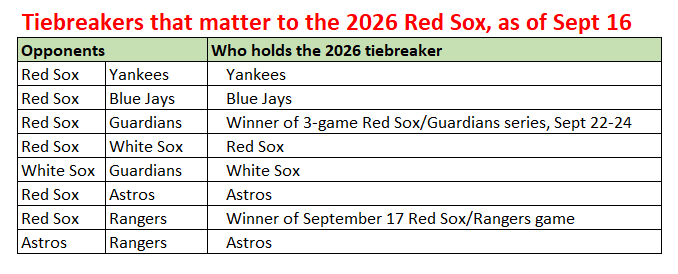
Notice that if the Rangers win all 6 of their remaining games, and the Red Sox lose all 6 of theirs, that the Rangers would only manage to be tied with the Red Sox. But because they hold the tiebreaker over the Red Sox (having won 4 of the 7 games played between them this year), the Rangers would beat out the Red Sox in that case.
The same goes for Detroit. The Tigers must lose all 6 of theirs, and the Rangers must win all 6 of theirs, for the Rangers to tie; because they win the tiebreaker (having won 4 of 6 against the Tigers), the Rangers would beat out the Tigers.
The Rangers did not win their season series against the Astros, however, so must beat them by a game in the final standings, to pass them for a playoff spot. Because they are currently 5 games behind them, that could only happen if the Rangers win all 6 of their remaining games, and the Astros lose all 6 of theirs.
For the Rangers to catch the Guardians, they’ll have to win some of their remaining 3 games against them; those wins would give the tiebreaker to the Rangers. So the Rangers could stand to lose 1 game, or could stand the Guardians winning 1 game, and still beat them for a playoff spot.
Given that there’s only 1 team that isn’t forcing the Rangers to win all their remaining games, but that they need to beat at least 2 of these teams, the only option for the Rangers is to win all their remaining games.
Let’s start a list of requirements like this one:
We’re assuming here that every game a team plays the rest of the way has a 1/2 chance of being a win, and a 1/2 chance of being a loss. Because the Rangers have 6 games remaining, and there’s only 1 way to achieve the stated outcome (Rangers win all 6), that’s 1 outcome out of 26 possible outcomes, or a 1/64 chance of it happening.
What other outcomes must we consider?
Well if none of these teams were playing each other in these final 6 games, it would be a little less complicated. All the outcomes would be independent, so we could calculate the odds of each team’s win totals independently, as a starting point. Our list of requirements would look like this:
Because the Rangers would have to beat at least 2 of these teams, we’d take pairs of outcomes and calculate their odds:
[ (Red Sox lose all) AND (Tigers lose all) ] OR [ (Red Sox lose all) AND (Astros lose all) ] OR [ (Red Sox lose all) AND (Guardians lose 5 or 6) ] OR [ (Tigers lose all) AND (Astros lose all) ] OR [ (Astros lose all) AND (Guardians lose 5 or 6) ]
Notice that we didn’t include (Tigers lose all) AND (Guardians lose 5 or 6). That’s because one of those teams will win the central division; beating a division winner doesn’t help you win a wild card spot. They have to beat at least one of the Red Sox or Astros to get into the playoffs.
So we would multiply odds everywhere there’s an AND above, and then add them everywhere there is an OR above.
This would double-count or triple-count some cases though. For example, it would triple count the case where all three of these occur: (Red Sox lose all) AND (Tigers lose all) AND (Astros lose all). We’d have to subtract out double the odds of that happening.
After making a few more adjustments where 3 of those occur, we’d probably have one final adjustment to make for the case where all 4 occur:
(Red Sox lose all) AND (Tigers lose all) AND (Astros lose all) AND (Guardians lose 5 or 6).
Then we’d multiply our result by the odds of the Rangers winning all their games, because that has to happen in every case of the Rangers making the playoffs.
But we don’t live in that world. We live in a world where, in the final games of the season:
The Tigers play 3 games against the Red Sox The Tigers play 3 games against the Guardians The Rangers play 3 games against the Guardians
Oh my. This reduces the number of games that determine the Rangers’ fate from 30 down to 21. That’s good for the Rangers, because it means a lot fewer games would have to go a certain way for them to make the playoffs, and that gives them better odds.
It also changes how we do this. Now the outcomes we need to consider look like this:
I’ve used highlighting to show outcomes that are related to each other in that they cannot both happen. For example, looking at the two lines in gold, we see that the Red Sox cannot simultaneously lose all their remaining games while also winning all 3 against the Tigers.
Let’s consider those two middle lines right now. If the Tigers lose all their remaining games, that means both the Red Sox and Guardians win at least 3 games. And that means the Rangers can’t beat either of those teams. The only team left that they could beat is the Astros. So if the Rangers beat the Tigers, they must also beat the Astros (and only the Astros) to get into the playoffs. That gives us this:
(Tigers lose all) AND (Astros lose all)
Which is actually this:
(Red Sox win all 3 against the Tigers) AND (Guardians win all 3 against the Tigers) AND (Astros lose all)
And there is no chance of double-counting with other outcomes. This will very much simplify our work to compensate for double countings.
To this we add the following:
[ (Red Sox lose all) AND (Astros lose all) ] OR [ (Red Sox lose all) AND (Guardians lose 5 or 6) ] OR [ (Astros lose all) AND (Guardians lose 5 or 6) ]
But consider that in the end we’ll be multiplying everything by the odds of (Rangers win all), which must happen in every scenario. Because the Rangers play 3 of those games against the Guardians, that means three of the Guardian’s losses have already been accounted for by the (Rangers win all) outcome. So we only need to consider the additional chance that the Guardians lose 2 or 3 against the Tigers. So the above becomes:
[ (Red Sox lose all) AND (Astros lose all) ] OR [ (Red Sox lose all) AND (Guardians lose 2 or 3 to Tigers) ] OR [ (Astros lose all) AND (Guardians lose 2 or 3 to Tigers) ]
Notice that in all 3 of these scenarios, the Tigers become unreachable to the Rangers, because they win at least 2 games. The only double or triple counting in this trio of scenarios is where the Rangers beat everyone but the Tigers:
(Red Sox lose all) AND (Astros lose all) AND (Guardians lose 2 or 3 to Tigers)
That’s a triple-count, so we have to subtract double the odds of that happening.
We can put all this together, with odds, in a new chart:
We add the first four lines then subtract 2 times the last line to compensate for double counting:
Which we multiply by the odds of the Rangers winning all 6 of their remaining games, to give 65/262144. That’s about 1 in 4033, or 0.0248%.
Had it not been for teams playing each other, the odds would have been 1 in about 16,186. So the Ranger’s chances of making the playoffs are about 4 times better because of these teams playing against each other.
There is a very very narrow range of circumstances under which the Toronto Blue Jays do not make the playoffs. So narrow, in fact, that if we assume every game remaining in the MLB this year has a 50% chance of being won by either team, the odds of the Blue Jays failing to make the playoffs are 1 about 793,072. That equates to a 99.999874% chance that they make the playoffs.
So how do we work out such numbers? Buckle up for a logic roller coaster ride.
To fail to get into the playoffs, every one of the Yankees, Red Sox, Mariners, Astros, Tigers, and Gaurdians would have to beat the Blue Jays, and these are the only 6 teams capable of surpassing the Blue Jays at this point.
At this point, the Blue Jays can end up with at most 73 losses, if they lose all 7 of their remaining games. So surpassing them would especially require a lot of winning by the Gaurdians and Astros (with 71 losses each currently) and the Red Sox and Tigers (with 70 losses each).
But these teams are limited in how much winning they can do the rest of the way, because there will be 6 games played between them. The Tigers and the Gaurdians will play 3 games against each other, and the Tigers and the Red Sox will play 3 against each other. That means there will be at least 6 losses spread around among those 3 teams.
So let’s consider the possible outcomes of the Tigers/Gaurdians series. For each outcome, let’s assume the Blue Jays lose all 7 of their remaining games, ending with a record of 89-73. Let’s also assume both the Tigers and the Gaurdians win all 4 of their other remaining games.
Except that we can’t assume that. Because if the Tigers win all their other 4 games, that means they deliver 3 losses to the Red Sox, who end up at best 89-73, the same as the Blue Jays. Because the Blue Jays end up with 7 wins and 6 losses against the Red Sox, they win the tiebreaker with the Red Sox and are in the playoffs. So the Tigers must lose a game to the Red Sox, and the Red Sox must win their other 4 games not against the Tigers, for the Blue Jays to have a chance at elimination here.
So we’ll assume the Tigers lose 1 more game (versus the Red Sox) outside of the Tigers/Gaurdians series, and the Guardians don’ t lose any others.
If the Gaurdians sweep the Tigers, the Tigers end up 88-74, a game behind the Blue Jays, and the Blue Jays are in the playoffs.
If the Tigers sweep the Guardians, the Gaurdians end up 88-74, a game behind the Blue Jays, and the Blue Jays are in the playoffs.
If the Gaurdians win 2 of 3, the Tigers end up 89-73, tied with the Blue Jays. Because the Blue Jays had 4 wins and 3 losses in their games against the Tigers this year, they win the tiebreaker between the teams, and are in the playoffs.
That leaves the scenario where the Tigers win 2 of 3. Then the Tigers end up 90-72, ahead of the Blue Jays, while the Guardians tie the Blue Jays at 89-73. So as a tiebreaker we look and see that the Blue Jays and Gaurdians each won 3 games against each other this year. We have to use the second tiebreaker, which is records within their own divisions. The Gaurdians end up 36 and 16 against their weaker division; the Blue Jays 25 and 27 against their stronger division. The Gaurdians therefore win this tiebreaker, and the Blue Jays are out of the playoffs – if the other 3 teams surpass them too, that is.
That’s the only scenario in which the Blue Jays are eliminated.
What if The Tigers lose one more game against another opponent? Then they end up with the same record as the Blue Jays, and the Blue Jays are in because they win the tiebreaker with the Tigers. So the Tigers must only lose the one game against the Red Sox.
That covers what must happen with the Tigers, Gaurdians, and Red Sox. What of the Yankees, Mariners, and Astros?
The Blue Jays hold the tiebreaker over the Yankees, so the Yankees must get to at least 90 wins, and therefore must win at least 3 of their last 7 games.
The Blue Jays hold the tiebreaker over the Mariners, so the Mariners must win at least 4 of their last 7 games.
The Astros hold the tiebreaker over the Blue Jays, so they must win at least 5 of their last 7 games.
So now we must get the odds of all these things happening and multiply them together to get the odds that the Blue Jays miss the playoffs. We assume in every game that the teams have an equal chance of winning. The following table contains all the odds:
The reason the Mariners and Astros are lumped together in the last line is that they play one more game against each other, so their odds of reaching their respective win totals are linked because of that game.
When you multiply all these odds together you get 693,198 divided by 2 to the 39th power, which is about 1 in 793,072, or 0.000126%. That’s the odds that they don’t make the playoffs; so the odds that they make the playoffs are about 99.999874%.
We are at nearly the halfway point in the season, and I’ve been noticing the Red Sox do some similar things to last season. They sure seem to be hitting the .500 mark a lot. They’ve been 18-18, 19-19, 20-20, and more. Now they’re 40-40. So I wondered, how are they stacking up to last season, when I granted them the title of the Most .500 Team in Baseball?
They are excelling, actually. Right now they have the lead.
If you measure by who has the most nearly .500 record, they lead all of baseball there:
If you look at that “Games above .500” column, the Red Sox are the only team at .500. And while teams that have played an odd number of games can be no closer than 1 game from .500, no teams are that close. The Sox are clear “winners” in this category.
We can also look at the number of times a team has been at .500 during the season. This gives an idea of whether the team has consistently played like a .500 team through the year. This time we’re looking at that “Times at .500” column:
Showing just the top 8 teams here. The Red Sox and the Reds are clear leaders in this category.
One more. We can look at which teams have the smallest difference between runs scored by them and runs scored against them. This we have in the Run diff column. Negative numbers mean the team allowed more runs than they scored.
The Red Sox are among the 4 leaders here.
But what I find more interesting is to consider balancing a team’s record against their run differential, because some teams have a positive run differential but a losing record, or vice versa. We have four good examples of this, this year. Now there are those who take a team’s run differential and convert it into a number of expected wins and losses for a team. So I took the difference of those for each team to get an expected number of games above .500 for those teams (see the “Expected GA .500” column). Then I averaged this with their actual games above .500 to see where the expected and actual balance out. These averages are listed in the “Ave GA XGA” column.
The Braves, Rangers, Blue Jays, and Gaurdians all have this contradiction of either a losing record and more runs scored than allowed, or vice versa. And there with them in the top 6 spots are the Red Sox.
There’s one team near the top of all these lists – The Boston Red Sox. If they go on to have a mediocre second half, they could repeat as Most .500 Team two years in a row. But with Alex Bregman coming back before long, and the rookies and second-year players getting better, and the pitching getting better, the Red Sox are looking like a team that will finish pretty well above .500 this time, so a repeat may not be in the cards. But they sure are off to a “good” start.