
Friday night (April 18, 2026) the Boston Red Sox got a thrilling 1-0 win in 10 innings over the Detroit Tigers.
Which pitcher did the most to help them win?
Here are the stat lines of their 3 pitchers in this game:
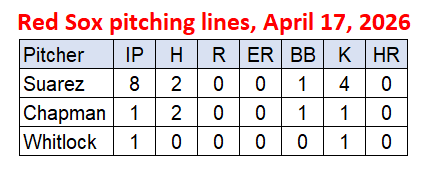
It should be clear that Ranger Suarez’s 8 shutout innings did more to help the Red Sox win than did Aroldis Chapman’s and Garrett Whitlock’s 1 shutout inning apiece.
But the win went to Whitlock, not Suarez.
This happens a lot, in my opinion. Too much. So many pitchers who deserve the win don’t get it, because of rules made in 1950 to finally consolidate all the competing standards for which pitcher should get the win. And when the top pitchers were still the only pitcher to pitch in the game for their team, in most of their starts. Changes in the game have made the use of relief pitchers an every-game occurrence, and have exposed the unfairness of these rules.
In my initial posts about this, Fixing how wins are awarded in baseball, and The how and the why of awarding wins to pitchers by the Merit Method, I describe a different method for awarding wins that I came up with 2 decades ago to address the problems with the current system, and why I think it’s better. Let’s see how this method, which I call the Merit Method, applies to Friday’s Red Sox game.
First we determine how many runs per inning the Red Sox scored in the game. The scored their 1 run with one out in the 10th inning, so that’s 1 run over 9 ⅓ innings, or 3/28 runs per inning, or about .107 runs per inning.
Now we credit each Red Sox pitcher in the game with that many runs per inning they pitched.
| Pitcher | Runs credited for innings pitched (RC) |
| Ranger Suarez | 8 IP x 3/28 = 24/28 or .857 runs |
| Aroldis Chapman | 1 IP x 3/28 = 3/28 or .107 runs |
| Garrett Whitlock | 1 IP x 3/28 = 3/28 or .107 runs |
Now from this we subtract the actual runs each pitcher allowed in the game.
| Pitcher | Runs Credited (RC) | Runs allowed (R) | Runs Ahead (RA) |
| Ranger Suarez | .857 | 0 | .857 |
| Aroldis Chapman | .107 | 0 | .107 |
| Garrett Whitlock | .107 | 0 | .107 |
This gives a number for each pitcher called “Runs Ahead”. In this case, because no runs were given up by any Red Sox pitcher in Friday’s game, it’s the same as the Runs Credited for innings pitched for each pitcher.
The win then simply goes to the pitcher with the greatest number of Runs Ahead. In this case, it goes to Ranger Suarez, who as we decided before, did the most to help the team win the game.
Notice that the calculation of Runs Ahead is based on only two numbers – runs allowed, and innings pitched. That was a deliberate choice. These numbers are the only two real contributions a pitcher makes toward the goal of winning or losing a game. All other stats may describe how the pitcher gets to that goal, but only these two record progress toward the goal.
It’s a method that, I believe, will most closely align with the judgement “which pitcher did the most to help his team win the game”. I’d like to see it replace the current flawed methods. And then Ranger Suarez can get his win back.
Here are some other previous posts I’ve made about this method.
Garrett Crochet pitched the best start of the year but didn’t get the win. We can fix that.
Tanner Houck deserves a win for his 5 perfect innings – and here’s a way to give it to him
Flawed rules took Tanner Houck’s win away. We can give it back.
 The Baseballsphere Blog