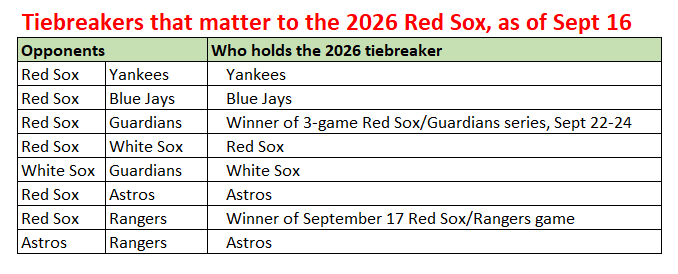
Yesterday NESN put up a graphic in the bottom of the first inning that gave two clinching scenarios for the Red Sox:
Red Sox win and Blue Jays win,
OR
Red Sox win, Rangers win, Astros lose.
This was incorrect. With a Red Sox win yesterday, nothing else was required. Not a Blue Jays win. Not an Astros loss. Just a Red Sox win by itself would have gotten the job done.
I saw the same mistake being made in social media from some pretty influential sources.
After thinking about it, I realized that they must not be accounting for the fact that the Red Sox hold the tiebreaker over the Texas Rangers, meaning that if the Red Sox and Rangers end up with the same record, and tied for a wild card spot, that the wild card spot would go to the Red Sox. And I wondered if they realized that the Red Sox hold the tiebreaker at all. So I will explain that all here.
First, we must realize that for the Red Sox to fail to make the playoffs, two teams must pass them in the wild card standings. Currently, there are only 4 teams that can surpass or tie the Red Sox in the standings; those are the White Sox and Guardians from the Central division, and the Astros and Rangers from the West division. But it’s not enough for, say, one team from each division to pass the Red Sox, because if only one team passed them, that team would end up being the division winner, and the remaining team ends up trailing the Red Sox in the wild card race.
That means that to knock the Red Sox out, all four teams would have to pass the Red Sox in the standings, or tie them and hold the tiebreaker.
And that means that if the Red Sox clinch over any one of those four teams, they’re in the playoffs. (There is a weird exception in which the Red Sox tie both the Guardians and White Sox, and don’t make the playoffs despite having the tiebreaker over the White Sox, but I don’t want to overcomplicate this discussion with that point right now.)
The Red Sox hold the tiebreakers over the White Sox and the Rangers right now. The Astros hold the tiebreaker over the Red Sox. For the Guardians, the tiebreaker with the Red Sox will be determined by the winner of their upcoming 3-game series.
To get the Red Sox magic number over the Astros, we have to recognize that the Red Sox must finish with a better record than the Astros, because the Astros hold the tiebreaker. That can be assured by the Red Sox win total added to the Astros loss total being a number that is at least 163. Because if it’s just 162, the Astros still have a chance of tying, and taking the wild card spot. So the formula we use is
(Magic number over Astros) = 163 – (Red Sox wins) – (Astros losses)
That number is currently 1. That’s why a Red Sox win or an Astros loss today gets the Sox in the playoffs, as many are saying today.
To get the Red Sox magic number over the White Sox and Rangers, it’s good enough for the Red Sox to clinch a tie, because the Red Sox hold the tiebreaker over both teams. So those formulas are
(Magic number over White Sox) = 162 – (Red Sox wins) – (White Sox losses)
(Magic number over Rangers) = 162 – (Red Sox wins) – (Rangers losses)
The difference being, we subtracted from 162 for teams over which we hold the tiebreaker, and from 163 for teams over which we do not.
Using this formula, the Red Sox magic number over the Rangers is currently 1. So a Rangers loss today, by itself, clinches a playoff spot for the Red Sox. But nobody is saying that.
There are only two possible explanations for this error. One is that people are using the first formula in all cases, even when the leading team (the Red Sox) holds the tiebreaker. The other explanation is that they just don’t realize that the Red Sox hold the tiebreaker over the Rangers.
In case that’s what it is, let’s look at why the Red Sox hold the tiebreaker over the Rangers.
MLB’s current tiebreaker rules can be found here: MLB playoff tiebreaker rules
Here is how they describe their first tiebreaker for a tie between two teams:
1. Head-to-head record
The first and simplest tiebreaker is the result of the season series between the tied teams. If Team X and Team Y tie for the top spot in the division and Team X went 10-8 against Team Y, then Team X is the division champion.
The Red Sox and Rangers have completed their season series against each other, with a 3-3 record. This rule does not resolve the tie. So we must go to the second tiebreaker rule, which they describe as follows:
2. Intradivision Record
If the head-to-head record is also a tie, then the involved clubs’ records within their division will break the tie. This applies even if the tie is for a Wild Card spot between two teams that do not reside in the same division. The team with the superior intradivision record would win the tiebreaker.
The Rangers have completed all their games against West division opponents this year. Their final intradivision record is 23-29.
The Red Sox have one game to go against the East division, to be played today. Depending on how that goes, they’ll end up with either a 26-26 or a 25-27 intradivision record. Either one of those is better than the Rangers intradivision record, which means the Red Sox hold the tiebreaker over the Rangers.
So to summarize, the Red Sox clinch a playoff spot today if the Red Sox win, or the Astros lose, or the Rangers lose. No combinations of events required. And unlike what many are saying, a Rangers loss by itself does the job.