
A lot of names have been mentioned as possible second basemen or third basemen for the Boston Red Sox in 2026. Some are already on the roster (Marcelo Mayer); some could be added by trade (Ketel Marte, Brendan Donovan); some could be picked up as free agents (Bo Bichette, Alex Bregman).
There are other names on the current Red Sox roster that have played significant time at second and/or third base, but are not mentioned in articles about who will get regular playing time in the Red Sox infield. And I have issues with this. Specifically, I have issues every time I read that Marcelo Mayer is presumed to be the player who will round out the infield after they acquire a second or third baseman. Because when I look at what Romy Gonzalez did in 2025, I see a guy who is no longer a platoon player, he’s a guy that deserves to play every day. In addition to that, his elite hard-hit rate makes him a breakout candidate, and I’m saying that despite the fact that he was already the second-best hitter on the Red Sox in 2025. His defense is not bad, it’s good enough, and his baserunning is a plus. He’s proven at the major league level, in ways that Marcelo Mayer isn’t. He can be relied on to produce good results in ways that Marcelo Mayer can’t yet.
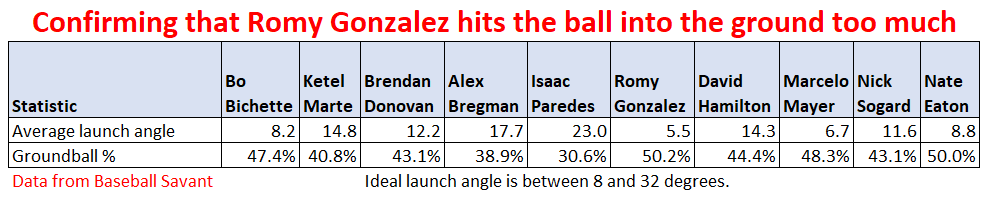
The thing that will allow him to break out? If he just stops hitting the ball into the ground so much. Of all the guys I’m comparing in this article, he does that the most. His average launch angle is the lowest. The result is that he’s one of the best in baseball at hitting doubles and triples, but his rate of home runs is a little below average.
He could also stand to chase less, and correspondingly increase his walk rate while decreasing his strikeout rate.
If you care about home runs, stikeouts, and walks, any of the 5 potential acquisitions (Bichette, Marte, Donovan, Bregman, Paredes) will be an improvement over Romy Gonzalez. But if you care about overall results at the plate, only Ketel Marte is looking like an improvement over Gonzalez. And when you factor in fielding and baserunning, there are some even bigger advantages for Gonzalez over most of these 5.
I’d hoped to discuss more specifics about comparisons of individual players, but I am finding it hard to find time to write this article. So I’ll just show you the tables I created to make these comparisons easy.
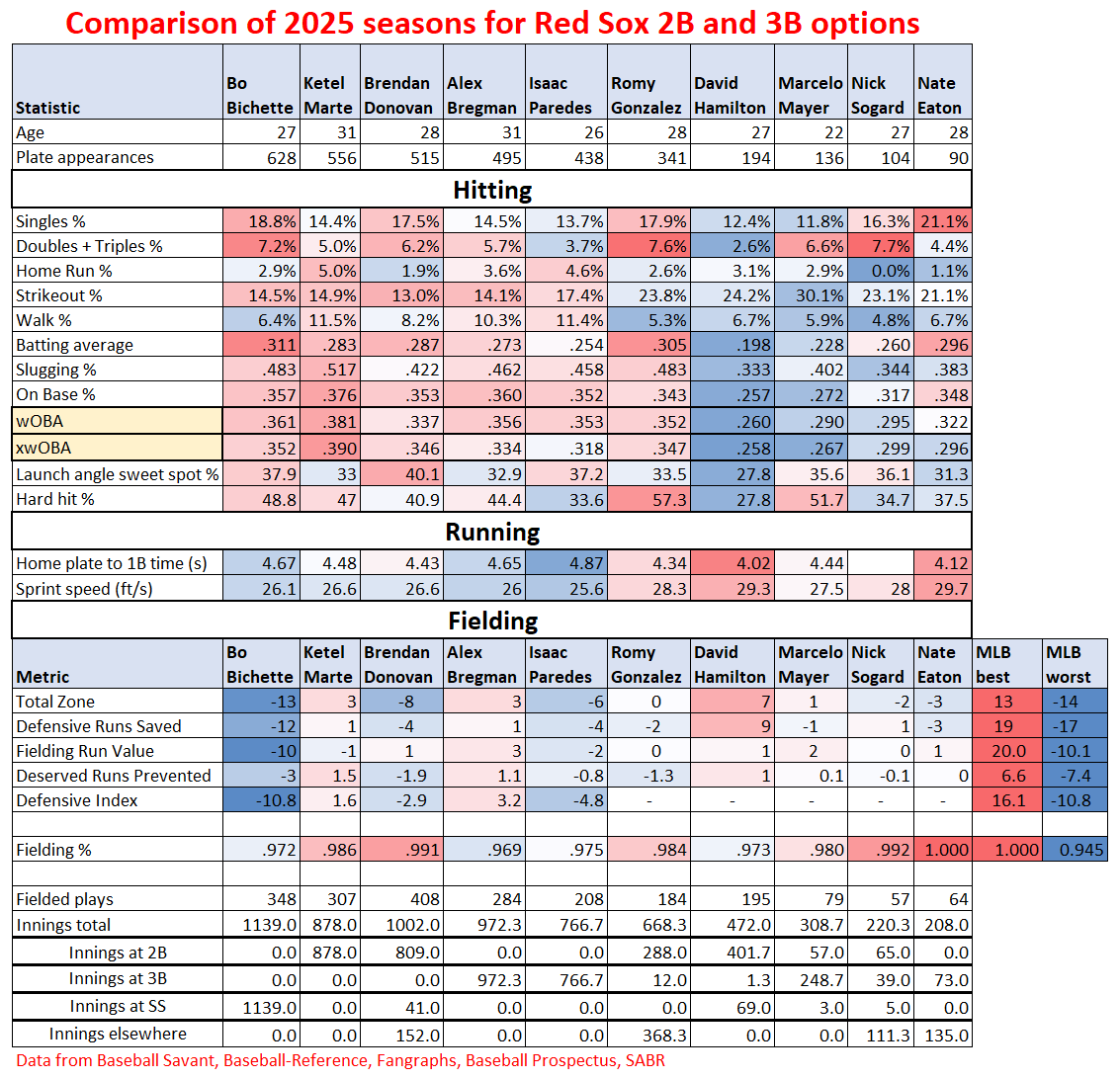
Here are the comparisons I’ve created for these players. The players are ordered left to right by most plate appearances in 2025.
Red means the number is above MLB average; blue means it’s below MLB average. White is MLB average. I set the deepest red to 2.8 standard deviations better than the mean (usually above, but sometimes below), and the deepest blue to 2.8 standard deviations worse than the mean. For hitting and baserunning, a table showing the numerical values of these standard deviations follows.
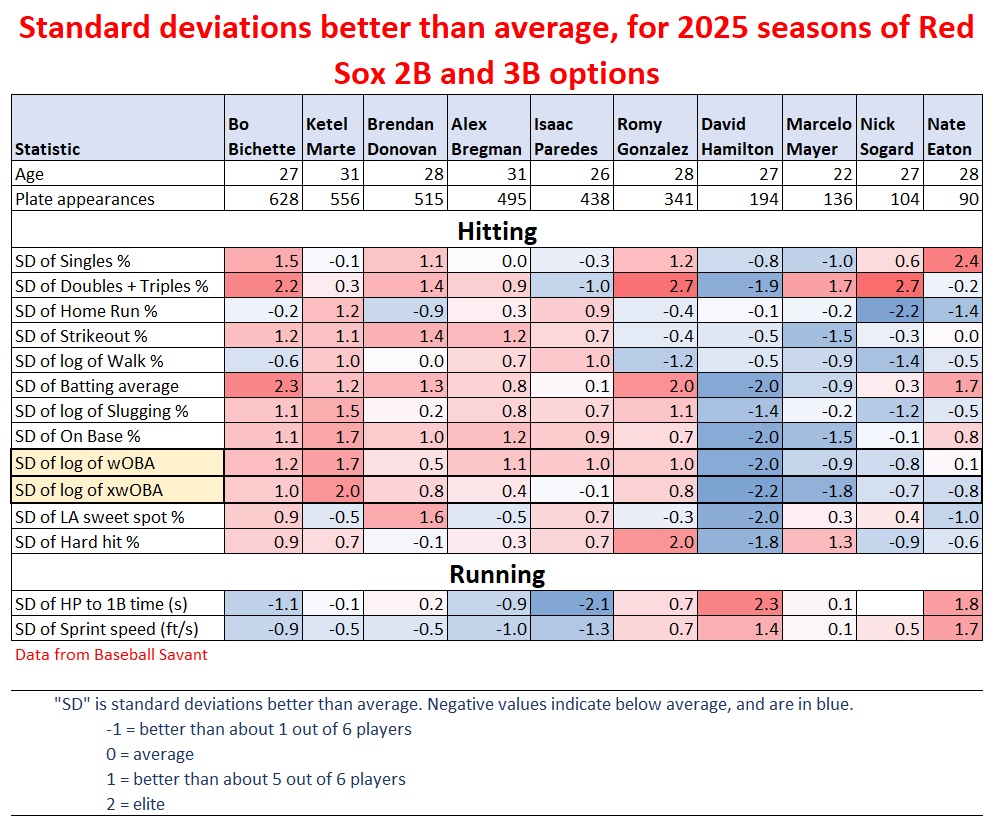
These same statistics expressed as standard deviations better (red) or worse (blue) than MLB average is below. In some cases, the data was more log-normal than normal, so I used standard deviations of the logarithm of the stat. These are labeled as such.
Here are the numbers supporting my previously mentioned statement that Romy Gonzalez can unlock a lot more power if he learns to elevate the ball. He hits it into the ground too much.
 The Baseballsphere Blog
One thought on “Comparing the 2025 seasons of Red Sox options for 2B and 3B”