
The worst Red Sox article from Wednesday, Feb 25

Yesterday’s Hall of Shame baseball article was by Daniel Fox of the Sporting News.

It includes this lie:
“the Red Sox’s overflow of left-handed hitters and the eventual need to move Devers down the defensive spectrum has led the team to shop their first baseman.”

What a doozy. Let’s break this down.

No shopping

The Red Sox have not shopped Triston Casas. That’s a myth that got started early after the 2024 season with a Ken Rosenthal speculated trade possibility. It was not based on any information about what the Red Sox were actually doing; it was just a guess at something they might try to do. But it got reported a lot. Then other prognosticators gave their dreamt-up trade scenarios involving Casas. And those got re-reported. Before long, a “where there’s smoke, there’s fire” mentality that developed among reporters, who started saying that they must be shopping Casas, given all this buzz about it.
But the Red Sox stated that no such thing was happening. They had to tell Casas that they had no idea where all these rumors were coming from, and that they intended to keep him.
At one point we did learn that Seattle had asked for Casas as part of a return for a pitcher that the Red Sox wanted, but the Red Sox essentially shut that down by saying Masataka Yoshida would have to be part of any trade involving Casas. That’s it. That’s not shopping Casas, but for some reporters it was enough to convince them.

    So the latter part of Daniel Fox’s sentence is a lie.

    No moving Devers

    There is no plan to move Devers to first base. Most people think that if Devers is moved, he would actually move to DH. There’s no reason to think he would be an improvement defensively over Casas at first, so this idea makes little sense.

    Also, Devers has clearly been promised by the team that he can stay a third baseman. He is highly opposed to playing anywhere else. They’ll likely need to keep him where he is.

    No overflow of lefties

    There is no overflow of left-handed hitters. The roster the Red Sox are most likely to open the season with would have more right-handed hitters than left-handed ones. For much of last year that was not true, because their two injured right-handed-hitting middle infielders (Story, Grissom) were replaced by left-handed hitters (Hamilton, Valdez). This helped cement their reputation as being to left-handed. But after Story and Grissom returned, all it took was one added right-handed bat to make them more right-handed than left. That happened when they signed Alex Bregman.

      But the real issue isn’t the number of right-handed hitters, it’s the number of players who hit left-handed pitching well. And when it comes to that, it turns out that Triston Casas has been the second-best on the current team at hitting lefties over the past two years, behind only Rob Refsnyder. And the best among regular starters. The idea of making the team better against lefties by removing Casas is absurd. A much better way would be to remove Masataka Yoshida or Wilyer Abreu.
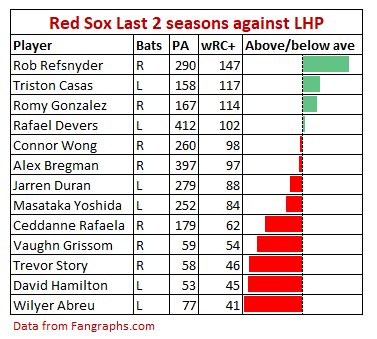
      Daniel Fox managed to pack a lot of wrong ideas into that sentence quoted above. It’s bad enough to add to the Hall of Shame.

      Alex Bregman’s contract at first appeared to be the biggest overpay in recent history – but it isn’t

      In my article from last December, Did the Mets overpay for Juan Soto?, I shared an analysis of all the signings of the biggest free agents (3.0+ WAR) going back to 2018. I compared the expected annual WAR of recently signed position player free agents (or free-agent-eligible players who were extended) to the average annual salary they got in their contracts. (I used the average of bWAR and fWAR, and because some players missed parts of seasons, I adjusted everyone’s WAR to a 150 game season.) I plotted the values of millions of dollars per WAR for each player against the year in which they signed or extended. I adjusted everything to 2024 dollars.

      Juan Soto was the biggest overpay according to that plot.

      After making that plot, and noticing a strong age-related trend, I made another plot that adjusted for age at the time of the signing. This was a plot of millions of dollars in annual salary per WAR over expected. Soto was not the highest on this plot, but near it, and he seemed to reset the market a bit. Most players this offseason have signed at “the high end of normal”.

      And when I then heard that Alex Bregman had signed with the Red Sox for $40M a year, I added him to the plot, and said “Alex Bregman just blew all that out of the water”. But, I was wrong.

      Here is the age-adjusted plot as I initially updated it, with Christian Walker, Teoscar Hernandez, and Alex Bregman added.

      Yikes. This isn’t even close. Everyone else is within $2M/WAR of their expected value, whether above or below. Bregman was more than $3.5M/WAR over.

      However, I then learned that much of his salary would be deferred, making his salary in terms of 2024 dollars around $31.7M per year. When I updated my charts with this new number, things became reasonable again. Here is the corrected version:

      He’s near the top, but no longer an extreme outlier – almost not an outlier at all.

      Things look even better for Bregman in the non-age-adjusted plot. Here is the initial, non-age-adjusted plot, with Bregman, Walker, and Hernandez added. Bregman’s contract had been the biggest overpay even without the age adjustment …

      … but after switching from the nominal $40M AAV to the Competitive Balance Tax value of $31.7M a year, he’s down into the pack:

      And given the very short term of the contract, being older at the time of signing matters less, because they’re all prime years.

      If you want to see the numbers behind this plot, here is the updated chart of data that I worked from, with Christian Walker, Teoscar Hernandez, and Alex Bregman added.

      I had Bregman’s expected pay per year at $24M to $25M, based on his trend in WAR values. So the $40M number was shocking. But the $31.7M sounded reasonable, especially given the short 3-year term for the deal, and the opt-outs. And the fact that the big contracts for Masataka Yoshida and Trevor Story would be due to come off the books at the same time – it makes it look as though the Red Sox are aiming to get back under the luxury tax threshold for 2028.

      What I didn’t factor in, though, is that Bregman is worth more to a team than his WAR indicates. He is the ultimate unofficial player-coach, on a team with so many young, new players who can use exactly that. He challenges young players to prepare in ways they’d never imagined before. He talks a ton to every player and has a lot of good advice.

      So what I’d initially called the “biggest overpay in recent history” by far, now looks like a completely reasonable contract.

      I’m sorry Red Sox, and Alex Bregman, for my previous harsh words on this.